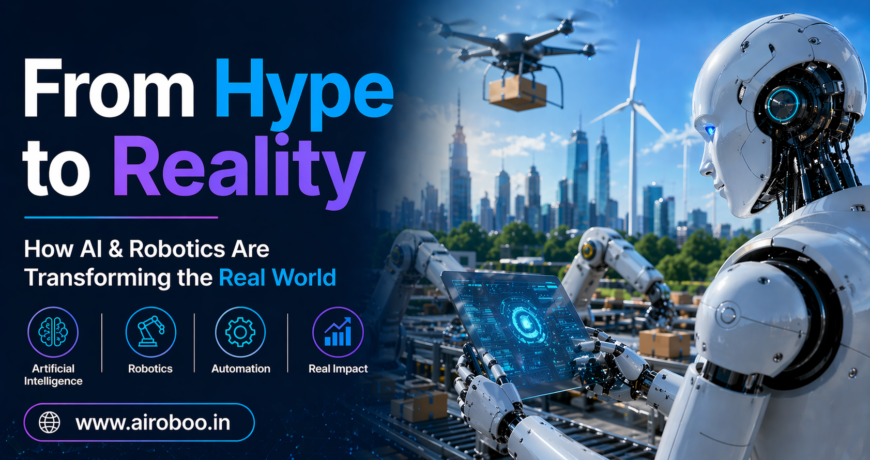
From Hype to Reality: How AI & Robotics Are Transforming the Real World Leave a comment
Artificial Intelligence (AI) and Robotics are no longer futuristic concepts; they are actively transforming how businesses operate today. What once lived in research labs and prototypes is now driving measurable outcomes across industries.
In 2026, the conversation around AI has shifted. Organizations are no longer asking “What is AI?” they are asking “How much value is it delivering?”
Recent insights show that nearly 25% of large companies are already seeing measurable ROI from AI adoption, highlighting a clear transition from experimentation to real-world execution.
The Rise of Physical AI
One of the most significant developments is the emergence of Physical AI the integration of artificial intelligence with machines and robotics to perform real-world tasks.
Today, nearly 79% of organizations are exploring or implementing AI-powered robotics, signaling rapid adoption across sectors.
Unlike traditional automation, modern robotics systems are:
- Adaptive
- Intelligent
- Capable of learning in real time
This allows them to operate in complex environments such as warehouses, hospitals, factories, and even homes.
Real-World Applications Across Industries
1. Manufacturing
AI-powered robots are optimizing production lines by:
- Reducing downtime
- Enabling predictive maintenance
- Improving precision with digital twins
2. Logistics & Supply Chain
Autonomous robots are:
- Streamlining warehouse operations
- Improving delivery speed
- Enhancing overall efficiency
3. Healthcare
Robotics is transforming healthcare through:
- Robotic-assisted surgeries
- AI-based diagnostics
- Patient care automation
The shift is clear: AI and robotics are no longer experimental technologies; they are operational essentials.
Robotics Is Advancing Faster Than Ever
The evolution of robotics is accelerating at an unprecedented pace. From industrial automation to humanoid robots, machines are becoming more capable of operating autonomously in real-world environments.
Modern robots are now:
- Perceiving surroundings
- Making decisions
- Executing complex tasks
This marks a major leap from rigid automation to intelligent systems.
The Workforce Shift: Humans + Machines
The biggest transformation is not just technological, it’s human.
AI and robotics are not simply replacing jobs; they are reshaping them.
New roles are emerging, such as:
- AI Trainers
- Robotics Operators
- Automation Specialists
This reflects a future where humans and machines collaborate, rather than compete.
However, the shift also brings challenges. Automation is expected to impact a significant portion of physical tasks in the coming decade, increasing the need for future-ready skills.
Challenges to Overcome
Despite rapid progress, adoption is not without hurdles:
- Reality Gap: Differences between simulation and real-world performance
- Safety & Trust: Ensuring reliability in physical environments
- Security Risks: Increased exposure as AI interacts with real-world systems
Organizations must address these challenges to scale effectively.
The Road Ahead: A Defining Decade
AI and robotics are entering a phase where they will:
- Observe
- Learn
- Adapt
- Act autonomously
While only a small percentage of companies are fully transformed today, a large majority expect this shift within the next few years.
This makes now the critical window for businesses and individuals to adapt.
Final Takeaway
AI and Robotics are no longer optional they are becoming foundational technologies across industries.
For:
- Students → Focus on hands-on learning
- Professionals → Upskill continuously
- Organizations → Invest in real-world implementation
Because in this new era, the leaders won’t just understand technology they will build with it.