The Uno R3 without Cable is a microcontroller board based on the ATmega328. It features 14 digital input/output pins (6 of which can be used as PWM outputs), 6 analog inputs, a 16 MHz ceramic resonator, a USB connection, a power jack, an ICSP header, and a reset button.
This board comes fully equipped to support the microcontroller, allowing you to connect it to a computer with a USB cable or power it using an AC-to-DC adapter or battery for easy initiation.
The name “Uno” signifies “one” in Italian and is associated with the release of Arduino 1.0. The Uno, along with version 1.0, serves as the reference model for Arduino moving forward. It is the latest addition to the series of USB Arduino boards and is considered the benchmark for the Arduino platform. For a detailed comparison with previous versions, refer to the index of Arduino boards.
Note: The Uno R3 reference design can use an Atmega8, 168, or 328, Current models use an ATmega328, but an Atmega8 is shown in the schematic for reference. The pin configuration is identical on all three processors.
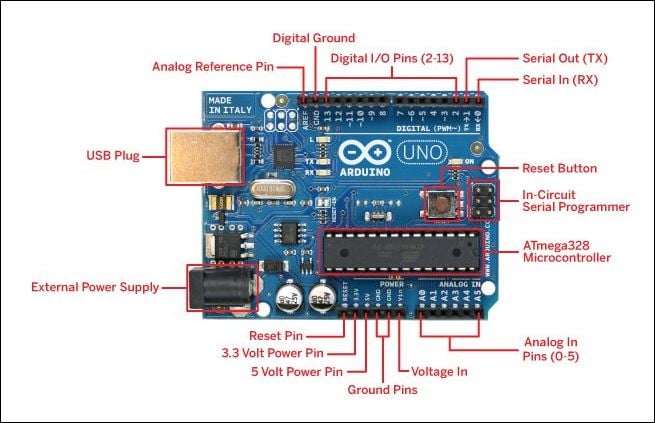
The Uno R3 is easy to power either through USB or an external source, automatically selected by the board.
For non-USB power, you can use an AC-to-DC adapter or a battery. Simply connect the adapter with a 2.1mm center-positive plug into the power jack, or insert battery leads into the Gnd and Vin pin headers.
The board operates on 6 to 20 volts from an external supply. For stability, it’s recommended to stay within 7 to 12 volts. Be cautious, as less than 7V may lead to instability, and exceeding 12V can overheat the voltage regulator.
Key power pins include:
– VIN: Input voltage from an external source.
– 5V: Regulated 5V output.
– 3V3: 3.3V supply with a max current draw of 50 mA.
– GND: Ground pins.
– IOREF: Provides the microcontroller’s voltage reference.
Memory:
– ATmega328 has 32 KB flash memory (0.5 KB for the bootloader), 2 KB SRAM, and 1 KB EEPROM.
Input/Output:
– 14 digital pins function as input/output.
– 6 analog inputs (A0 to A5) with 10-bit resolution.
– Specialized pins for Serial, External Interrupts, PWM, SPI, and TWI (I2C).
– AREF pin for analog input reference voltage.
Communication:
– UART TTL (5V) serial communication via pins 0 (RX) and 1 (TX).
– ATmega16U2 facilitates USB communication.
– Supports I2C and SPI communication.
Programming:
– Program using Arduino software, selecting “Arduino Uno” under Tools > Board.
– Comes pre-burned with a bootloader for easy code uploads.
– ICSP header for programming without the bootloader.
Auto-reset:
– Software-triggered reset for easy code uploads.
– Hardware flow control line (DTR) connected to the reset line.
USB Overcurrent Protection:
– Resettable polyfused protects USB ports from overcurrent.
Physical Characteristics:
– Dimensions: 2.7 x 2.1 inches.
– USB connector and power jack extend beyond dimensions.
– Four screw holes for attachment.
Note: If encountering errors during code uploads or port detection issues, consider uploading the bootloader.
Package Includes:
1 x Uno R3 Board without Cable compatible with Arduino


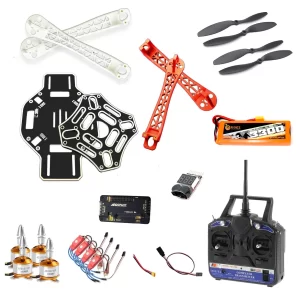 ARF Quadcopter Economy Combo Kit
1 × ₹14,266.00
ARF Quadcopter Economy Combo Kit
1 × ₹14,266.00  Raspberry Pi Camera Module 3 NoIR
1 × ₹3,299.00
Raspberry Pi Camera Module 3 NoIR
1 × ₹3,299.00  Raspberry Pi Build HAT
1 × ₹1,960.00
Raspberry Pi Build HAT
1 × ₹1,960.00  ODROID-XU4Q Single Board Computer
1 × ₹7,999.00
ODROID-XU4Q Single Board Computer
1 × ₹7,999.00 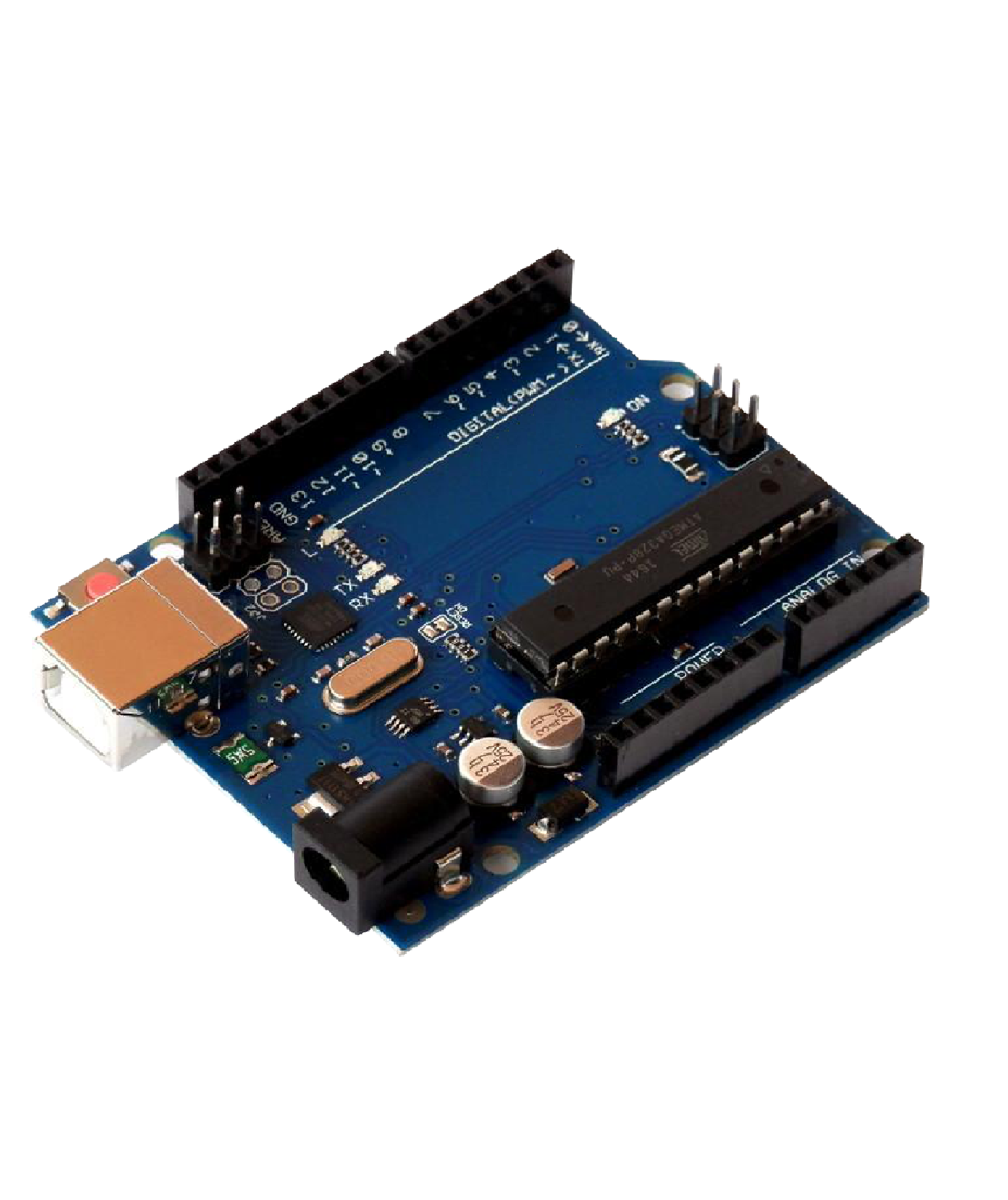










There are no reviews yet.